Defining the game interface and the lobby API
My first iteration of the imposter game was extremely coupled with the durable object itself. Though this worked for this game, it would probably cause some growing pains when building up and adding more games.
The software design pattern called the Strategy Pattern seems to fit perfectly for this usecase. I can define an interface for the games. The engine can then run the game through it's interface without needing to know the interal implementation of the game. This can allow me to plug in any implementation and still have it run in the engine.
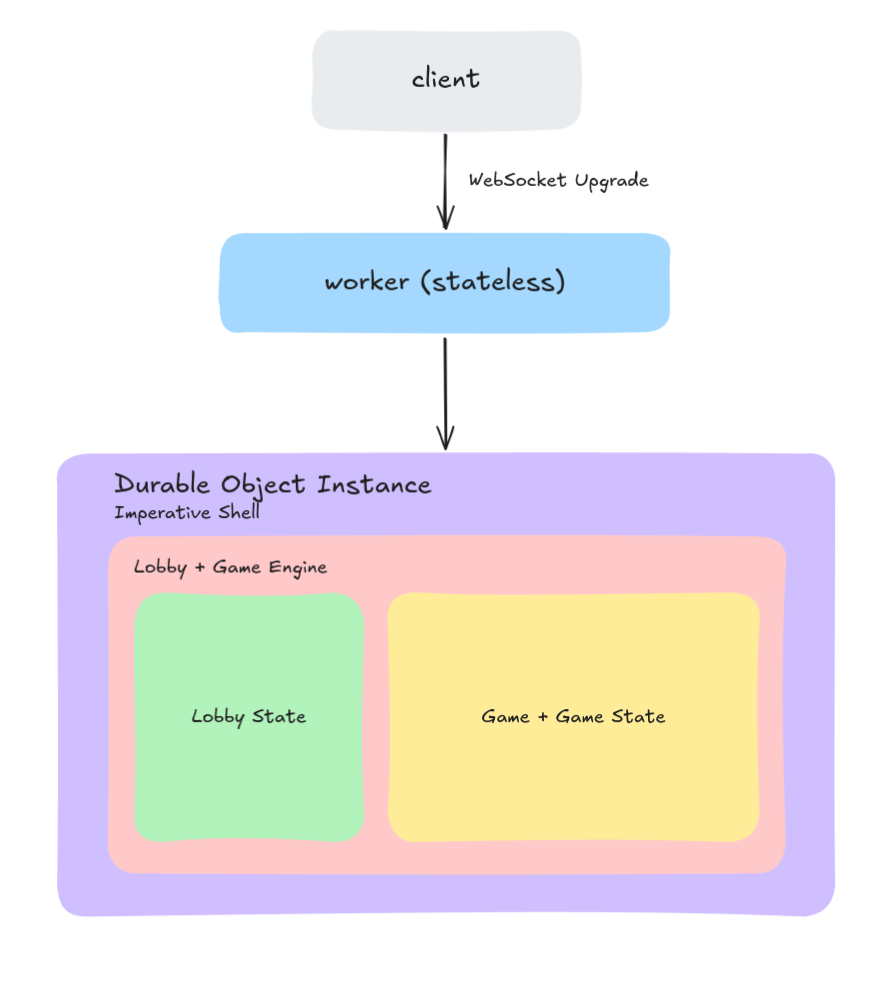
This resulted in a layered architecture, cleary separating responsibilities at every layer. The layers could communicate between one another with a custom protocol.
Layer 1 - Worker Entry
A thin router that forwards WebSocket upgrade requests to the Durable Object. This serves as the entry point to the lobby and handles assigning clients to the correct socket.
Layer 2 - The Durable Object shell
This layer is the base of the runtime handling all operations, from connections to lobby state, to game state. The Lobby Durable Object's reponsibilities include:
- Manage client connections
- Guard abusive connections
- Interface with storage API
- Handle the event loop (Alarms, WebSocket events, etc)
Layer 3 - The Lobby engine
Holds the root state for the lobby (players, hostId, selectedGame, isPlaying, timers, gameState). It modifies state through pure functions. The engine layer owns everything that is lobby-level rather than game-level:
- Join/identity rules (handleJoin)
- Host management: reassigns hosts when host loses connection
- Lifecycle: mid-game disconnects, idle-lobby disconnects, DO cleanup on no connections
- Apply game effects: Translates game effects into lobby effects
Layer 4 - The Game
The Game interface defines the contract. Games are fully pure and sandboxed by construction. Game implementations never see sockets, storage, or lobby state. A game only interacts with it's own state and communicates that and any other messages to the lobby through the defined protocol.
This interface also serves as an API for the game to handle bevahior in reponse to events in the lobby, such as providing behaviour on what to do if a player disconnects, or sends a message, etc.
You can see that most of the methods defined on the game interface return the GameTransition object. This object is how the game communicates it's state as well as any effects back to the engine. The engine is the layer that sits between the durable object and the game and enables communication between them.
The actions a game can take on the durable object (or lobby, can be interangeable here)
are defined through a protocol which is represented as the GameEffect type.
This design can be visualized like this:
interface Game {
    name: string;
    minPlayers: number;
    init(): GameTransition;
    onMessage(): GameTransition;
    onTimer(): GameTransition;
    onPlayerJoined(): GameTransition;
    onPlayerDisconnected(): GameTransition;
    onPlayerReconnected(): GameTransition;
    snapshotFor();
}

interface GameTransition {
    state: unknown;
    effects: GameEffect[];
}
type GameEffect =
  | { kind: "broadcast"; event: unknown }
  | { kind: "send"; to: PlayerId; event: unknown }
  | { kind: "setTimer"; id: string; at: number }
  | { kind: "clearTimer"; id: string }
  | { kind: "end"; summary: unknown };