Google sign-in, and moving the frontend from Vercel to Cloudflare Workers
My goals for this iteration were:
- Google sign-in with real accounts
- Require an account to host a room (joining stays open to guests)
- Verify sessions on the WebSocket upgrade without adding latency
- Get both apps onto the same platform
Up to this point, apps/huddl was deployed to Vercel while game-service
ran on Cloudflare Workers. Two platforms meant no shared bindings, so the
Next.js app couldn't touch the same storage the game Worker could. Adding
auth was the forcing function to fix that. I chose
better-auth for the auth layer, and it needs
a database for users and sessions plus a fast cache for session reads and
rate-limit state. On Cloudflare those map naturally onto
D1 (SQLite) and
KV, and the cleanest way to get
those bindings into the Next.js app was to run it on Cloudflare too. So the
frontend moved to @opennextjs/cloudflare,
which compiles the Next.js build into a Worker, and both apps have lived on
one platform since.
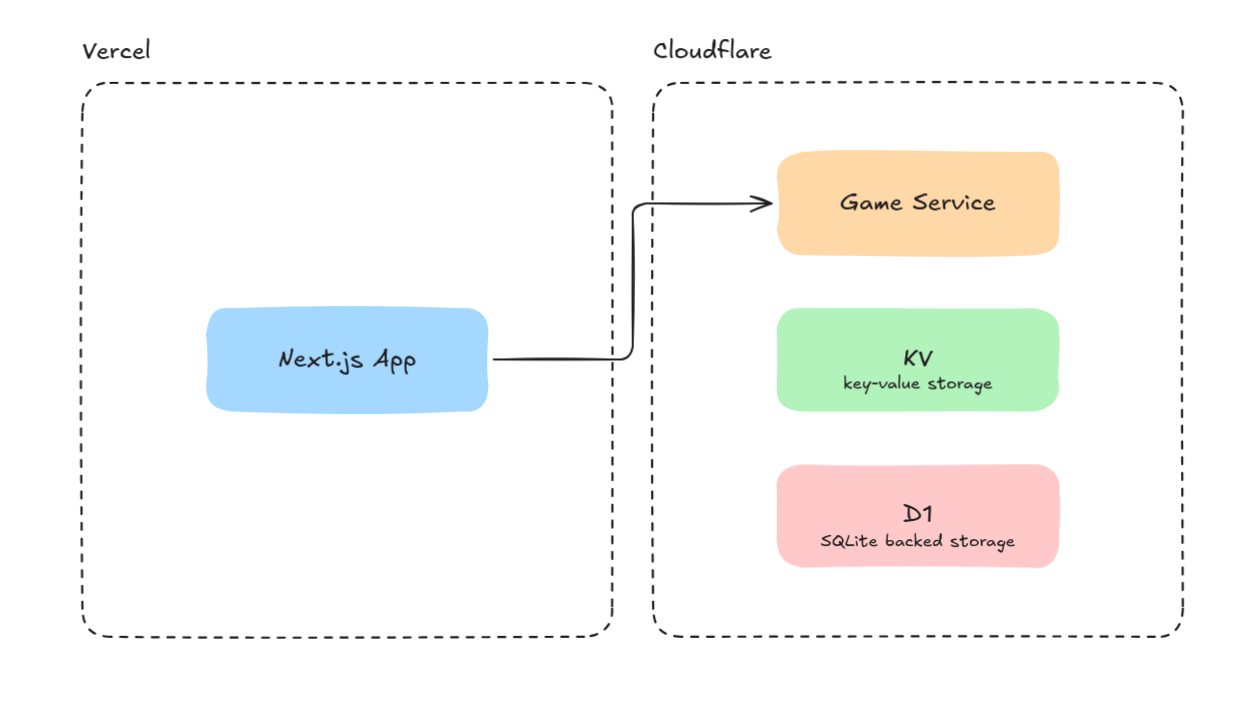
Before: Multi-cloud, hard to support better auth
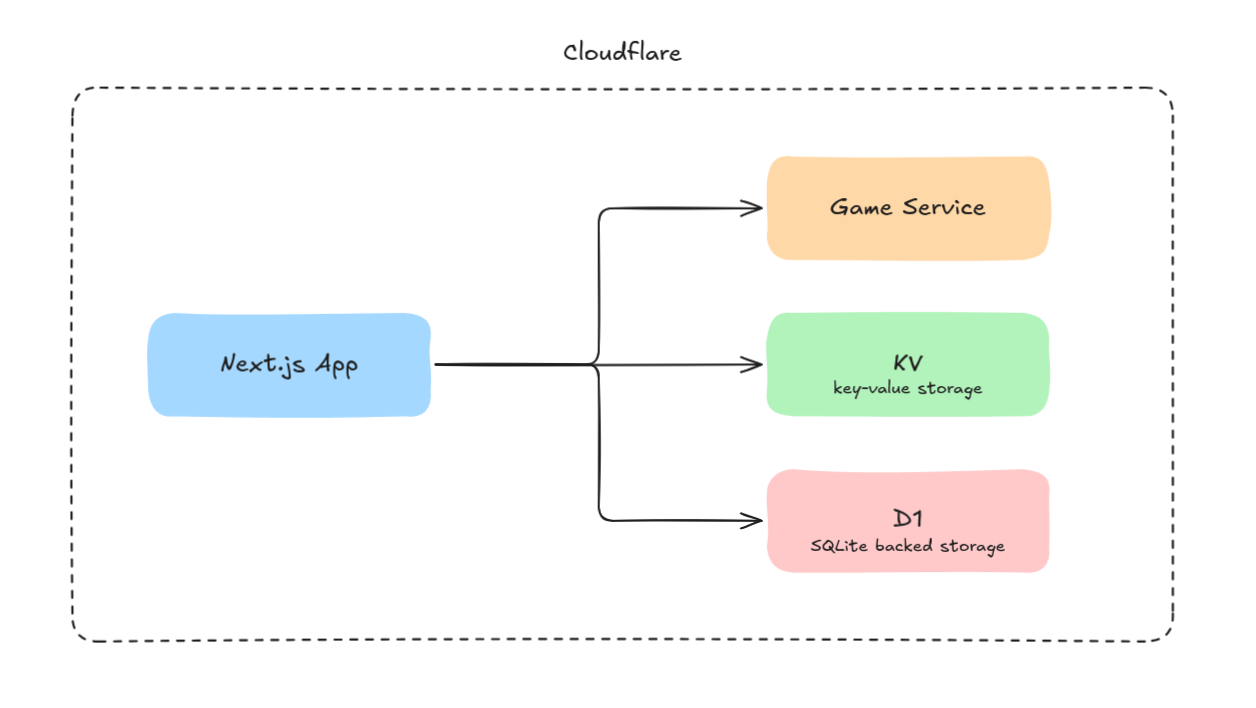
After: Single cloud, fully supported access to D1 and KV
The auth setup
better-auth runs inside the Next.js app and owns the whole sign-in flow. The configuration does a few things worth calling out:
- D1 is the source of truth. Users, sessions, and accounts live in
SQLite, accessed through drizzle.
storeSessionInDatabasestays on even though KV serves most reads, more on why below. - KV is the session cache. better-auth's
secondaryStoragewrites each session to KV keyed by the raw session token, with the session and user serialized as JSON. - Rate limiting rides on KV too, with tighter windows on the sign-in and OAuth callback routes. One catch: Cloudflare KV TTLs must be at least 60 seconds, so any rate-limit window below that would crash on write.
- The session cookie is scoped to
.huddl.gg. This is the quiet detail everything else depends on. The game Worker lives onapi.huddl.gg, and a host-only cookie would never be sent there.
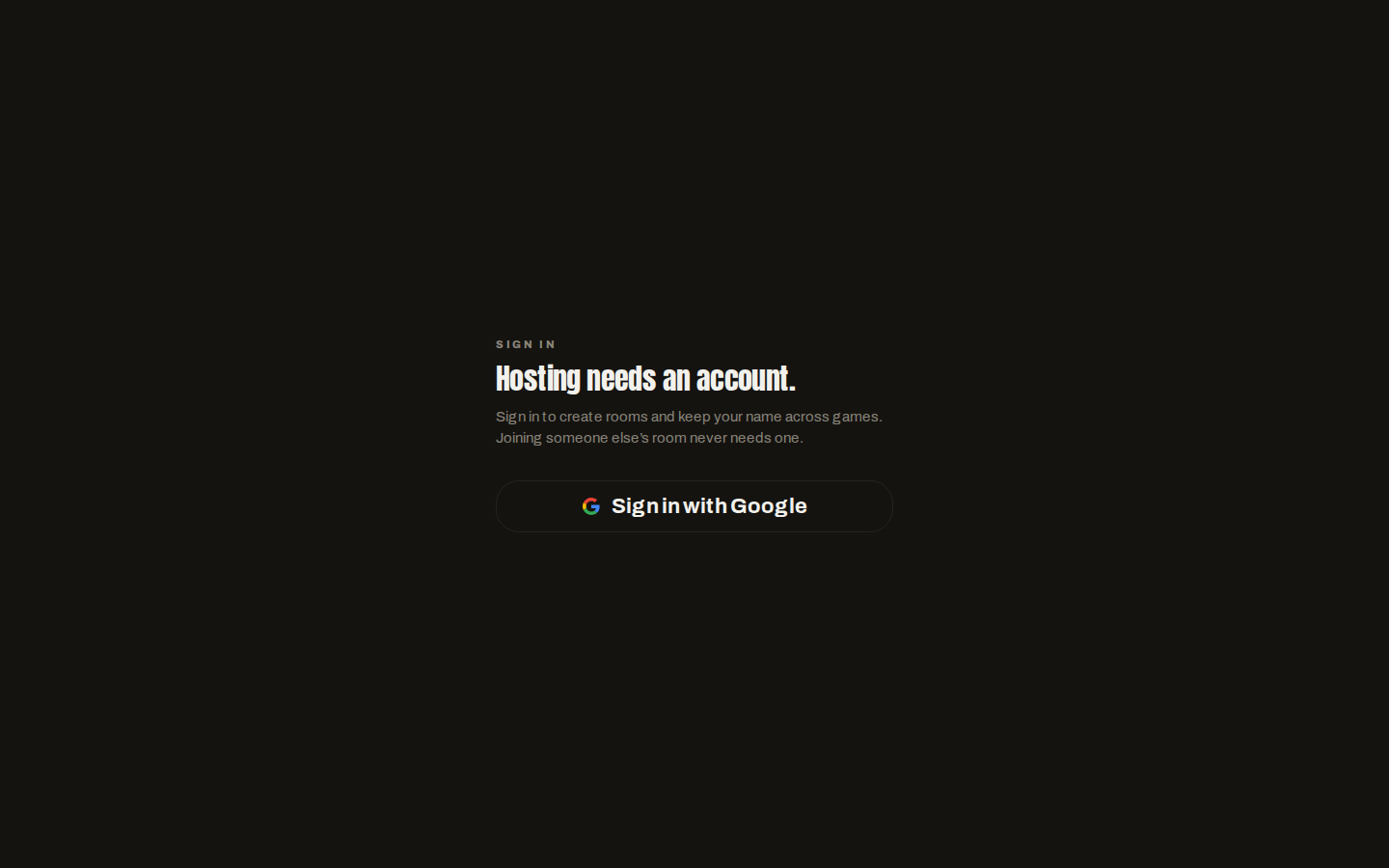
Verifying sessions on the WebSocket upgrade
The harder part wasn't the sign-in flow, it was what happens when a client
connects. game-service is a separate Worker from the Next.js app, so the
obvious approach is to call an API route on the app and ask "is this
session valid?". But that adds a network hop to every single connection
attempt, and it makes the game runtime depend on the frontend being
reachable at all.
Instead, the Durable Object verifies the session itself, in three steps:
- Read the cookie. The upgrade request carries
better-auth.session_token, whose value is the token plus an HMAC-SHA256 signature of it. - Check the signature locally. WebCrypto verifies the HMAC against
BETTER_AUTH_SECRET, a secret both Workers share. A forged or tampered cookie dies here without any storage read. - Look up the session. KV first, since it's the fast path. KV is eventually consistent though, so a miss falls back to a single D1 query joining the session and user tables, the source of truth.
Notice that an invalid or missing session doesn't reject the connection but
instead degrades to a guest identity. Joining an existing room shouldn't require
an account; only creating one does, and that gate lives in the lobby
engine's join logic rather than at the connection layer. The engine from
the last post already receives an identity on handleJoin, so the auth
layer just changed what that identity can be:
The tradeoff of doing verification in-Worker is coupling: game-service
now depends on better-auth internals: the cookie format, the signature
scheme, the shape of what secondaryStorage writes to KV. If better-auth
changes any of those, the fallback to D1 keeps sign-ins working but the
fast path silently disappears. I took that deal for zero added hops on
every connection and no runtime dependency between the two Workers.
async function authenticateRequest(
  request: Request,
  env: Pick<Env, "AUTH_KV" | "AUTH_DB" | "BETTER_AUTH_SECRET">,
): Promise<AuthContext | null> {
  const token = await getSessionToken(request, env.BETTER_AUTH_SECRET);
  if (token === null) return null; // null means "treat as guest", not "error"
  return validateSession(token, env);
}
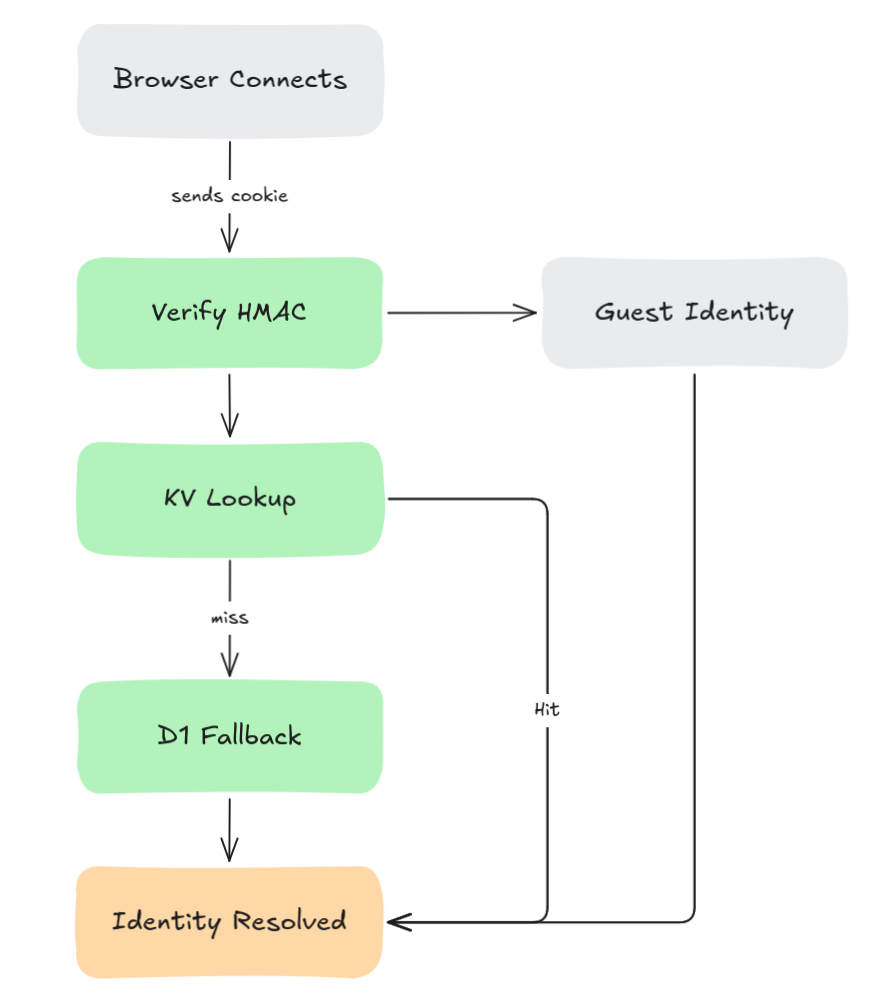
Session Verification Flow: the upgrade request path
type JoinIdentity =
  | { kind: "user"; userId: string; displayName: string | null; handle: string | null }
  | { kind: "guest"; displayName: string; guestId: string };
Alternative Session Hanlding
The alternative I've explored is instead having jwt based sessions rather than storage backed sessions. This would remove the need to verify against the DB's at all for session verification. There are tradeoffs to this approach, mainly you lose the ability to revoke a session or sessions. However the gains in reduced complexity seem worth it and make sense for an application with non-critical data.
With the JWT approach, verification would stop at the HMAC check. The JWT will contain all the details required by the service to identify the user.
A migration to JWT is likely next, however right now we do have a working auth solution
CI and typed secrets
CI grew a step this week too. wrangler types generates the Env
interface for each Worker, but it only includes secrets like
BETTER_AUTH_SECRET if a .dev.vars file exists when it runs. Real
secrets obviously never touch CI, so each Worker commits a
.dev.vars.example with placeholder values, and CI copies it into place
before generating types and typechecking. The secret names type-check;
the secret values stay out of the repo.